
LA County Voter Verification for Covina
Start with the Los Angeles County Registrar-Recorder/County Clerk's status verification tool. Covina is inside Los Angeles County, so the county lookup is the local status check for a Covina voter address. The tool is designed for a voter checking their own registration status; it is not a browseable list of residents, a neighborhood roll, or a public people-search database.
The county form is intentionally specific. It asks for a last name, birthdate, house number, and ZIP Code, which means a casual name-only search will not return a list of possible voters. If a Covina address uses a 91722, 91723, or 91724 ZIP Code, use the house number from the residence address tied to the registration, because the lookup is matching against the official voter record rather than a city directory.
| Lookup field | Entry type | Required | Format note |
|---|---|---|---|
| Last Name | Text | Yes | Alphabetic entry; the form requires a last name. |
| Birthdate | Date text | Yes | Use mm/dd/yyyy format. |
| House Number | Numeric text | Yes | Use the number from the residence address. |
| Zip Code | Numeric text | Yes | Use the ZIP Code on the registration address. |
Source lead-in: the screenshot below comes from the LA County voter status verification page listed in the Covina image manifest.
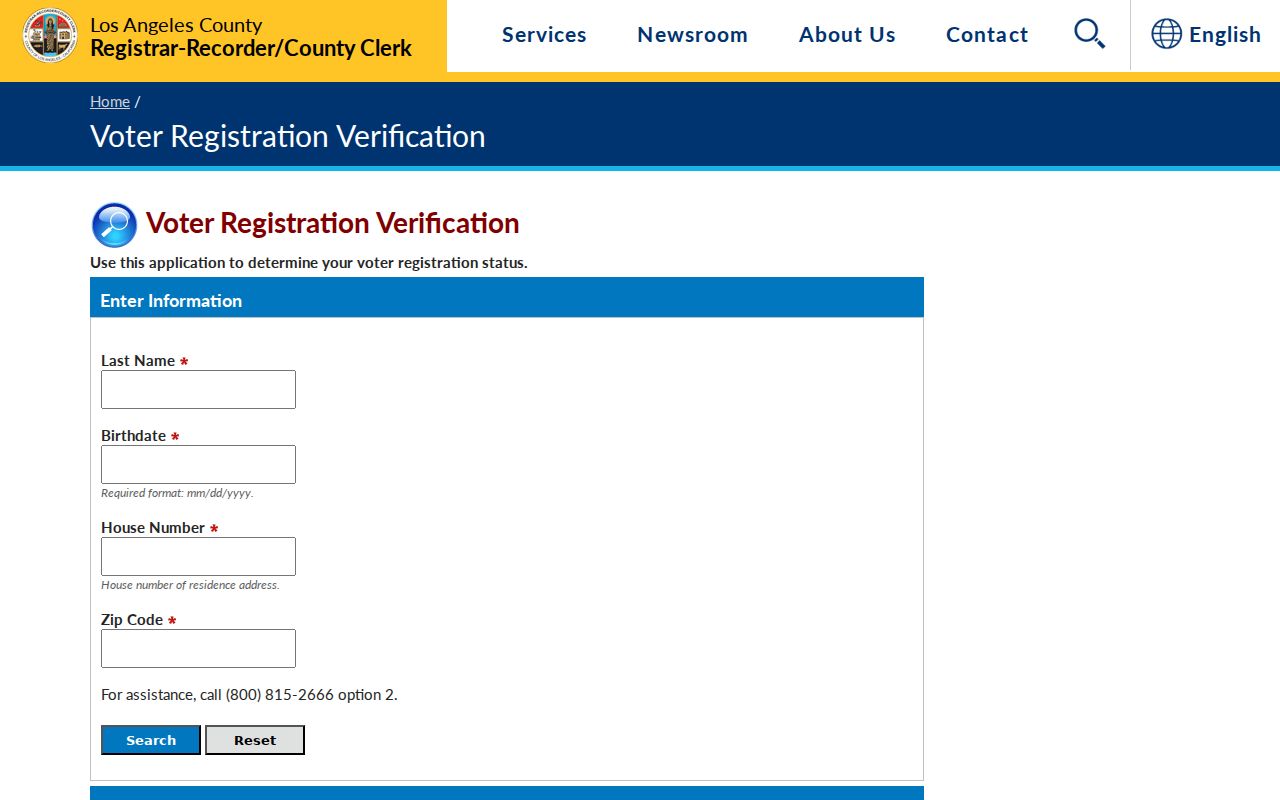
If the county lookup does not confirm the expected status, the voter assistance route documented in the research is LA County RR/CC at (800) 815-2666, option 2. That fallback matters when a voter has moved, recently registered, changed a party preference, or needs staff help with a record the web form does not explain.
California My Voter Status as a Second Check
California also runs My Voter Status, a statewide status tool from the Secretary of State. For a Covina voter, the state tool can confirm registration status, political party preference, language preference for election materials, vote-by-mail or provisional ballot status, and elected officials. The research did not capture the dynamic field labels from the state screen, so the county field table above is the reliable form inventory for this page.
Use the two tools for different purposes. LA County's verification page is the local county match, while My Voter Status is the statewide voter-facing account check. Neither tool turns California voter data into open public data. If the purpose is broader research, journalism, election work, or a legal record review, the route is the restricted voter-file request process, not repeated status lookups against individual people.
Covina Lookup Access Is Not the Same as the Voter File
The most important distinction in California is the difference between a status lookup and the voter file. A lookup is a controlled, voter-facing confirmation tool. The voter file is a dataset governed by state law, Secretary of State review, security promises, fees, and limits on the purpose of use. This is why a person looking for Covina voter records should not expect a free public roll that can be searched by name alone.
California Elections Code section 2194 says certain voter information may be provided for election, scholarly, journalistic, political, or governmental purposes as determined by the Secretary of State. The same section bars personal, private, and commercial uses, including harassment of a voter or household and advertising, solicitation, sale, or marketing. The practical result is a permissioned record set: real voter rolls exist, but access depends on who is asking, why they are asking, and whether they agree to protect the data.
What a California Voter Record Can Contain
State regulations describe voter registration information broadly. A record can include identity, address, election-administration, party-preference, language, and participation fields when those fields exist in the individual record. Participation history means whether and how a voter participated in an election; it does not show ballot choices.
| Registration county | Identifies the county election office holding the record; Covina records route through Los Angeles County. |
|---|---|
| Name and addresses | May include name, residential address, and mailing address, subject to confidentiality protections. |
| Contact fields | Phone number and email address may exist in the record inventory, but access is restricted. |
| Political party preference | Can be part of the voter record where collected for California election administration. |
| Status details | May include registration status, registration date, method, precinct, county voter ID, and status reason. |
| Voting participation history | May show election date and voting method, never candidate selections or ballot choices. |
| Vote-by-mail indicators | May show permanent vote-by-mail status or voting assistance request status where applicable. |
Confidential by law. Elections Code section 2194 and Government Code section 7924.000 protect specified voter-registration affidavit information from routine public display. Driver license numbers, California ID numbers, Social Security numbers, unique voter identifiers, and signatures are confidential, and confidential-voter programs can withhold protected records from public voter data requests.
Requesting the California Voter File for Covina Records
A qualified requester can apply to the Secretary of State or to a county for voter registration information. For Covina, a statewide, county, district, or specific-voter request can include Los Angeles County records if the requester qualifies and the purpose is approved. The statewide Secretary of State process requires an original signed application; email and fax applications are not accepted.
| Request element | What the application asks for | Covina relevance |
|---|---|---|
| Applicant identity | Full name, phone, email, business address, mailing address if different, and current driver license or state ID copy. | Shows who is responsible for the Covina or LA County data requested. |
| Requester type | Political campaign or committee, academic, media, private vendor, legal, governmental, investigation, or other. | The requester category must fit an approved use. |
| Purpose | Candidate, ballot measure, political research, scholarly research, governmental, initiative, referendum, recall, record review, or other explanation. | Personal curiosity is not enough for the full voter rolls. |
| Data scope | Statewide, county, district, or specific voter; inactive records, voting history, and precinct-to-district data choices. | A Los Angeles County or district scope may be narrower than statewide data. |
| Security agreement | Explanation of intended use, secure handling, initials, original wet signature, and agreement to restrictions. | The applicant takes responsibility for protecting any Covina voter data received. |
| Fees and delivery | Statewide application fee is listed as $100; regulations also describe $15 per 1,000 records up to $100, minimum $15. Specific voter record requests are $30 per record up to $100 and limited to 10 records per application. | Use the current Secretary of State fee instructions at filing time. |
- Choose the scope: statewide, Los Angeles County, political district, or up to 10 specific voters.
- Complete the Secretary of State voter-file application with the requester category, purpose, data choices, security explanation, and ID copy.
- Mail or hand-deliver the original signed application to Secretary of State, Elections Division, 1500 11th Street, 5th Floor, Sacramento, CA 95814.
- Allow for review in order received. The research reports a typical 7-14 business day review period.
- Receive approved county, statewide, or district data on encrypted DVD in tab-delimited files, or specific voter records by encrypted WinZip email attachment.
Use Restrictions and Penalties for Voter Records
California's voter records rules are strict because the data can include addresses, contact details, political preference, and participation history. Elections Code section 2194 bars unapproved personal, private, and commercial use. The research also flags Elections Code section 18109: misuse of voter file information can be a misdemeanor and may involve significant fines.
Do not use voter data to harass a voter or household, publish restricted data online, leave data unsecured, transfer the file without authorization, or use it for advertising or marketing. California Penal Code section 646.9 and section 653m separately address stalking and harassing communications, so misuse can move beyond election-law consequences if the conduct targets a person. For a lawful Covina research project, keep the purpose tied to election, civic, scholarly, journalistic, governmental, or approved record-review work and preserve the security promises made on the application.
Safe at Home and Confidential Covina Voters
California's Safe at Home program is a major exception layer for address-based records. The Secretary of State program provides a substitute mailing address accepted by state, county, and city agencies for eligible participants, helping keep residence addresses out of public-facing records. The research notes that Safe at Home was established in 1998 and began in July 1999.
For voter data, the effect is direct: confidential voter records under Elections Code sections 2166, 2166.5, 2166.7, and related programs are not included in Public Voter Registration Data Requests. A Covina voter participating in an address-confidentiality program should not be expected to appear in the same way as an ordinary record. Researchers should treat missing or shielded address details as a legal protection, not a data-cleaning problem to work around.
Historical Voter Rolls and the Covina Research Gap
Current voter registration records are not the best tool for genealogy or older residency research. Covina was founded in 1882 and incorporated on August 14, 1901, while many Los Angeles County record sets begin earlier. Historical voter registers, poll books, and related county election records may be held in archives, libraries, county record groups, or genealogy collections rather than modern election portals.
The research did not confirm exact Los Angeles County or Covina poll-book coverage years. That gap should stay visible. For older Covina residents, pair election-history research with the California State Archives family-history resources, Los Angeles Public Library city and street directories, the California State Library's directory collections, and local historical holdings. Those sources can establish residence, occupation, household movement, and local civic presence without forcing modern voter registration data into a role California law does not allow.